
Making the decision to straighten your teeth is the easy part. You know you want a healthier smile and the confidence that comes with it. But then comes the hard part: choosing how to do it.
Decades ago, there was really only one option: metal tracks. Today, you are spoilt for choice. From traditional metal to clear orthodontic braces and removable aligners like Invisalign, the options can feel overwhelming.
While all these tools share the same goal—to move your teeth into their perfect position—the experience, the look, and the impact on your daily lifestyle are very different for each.
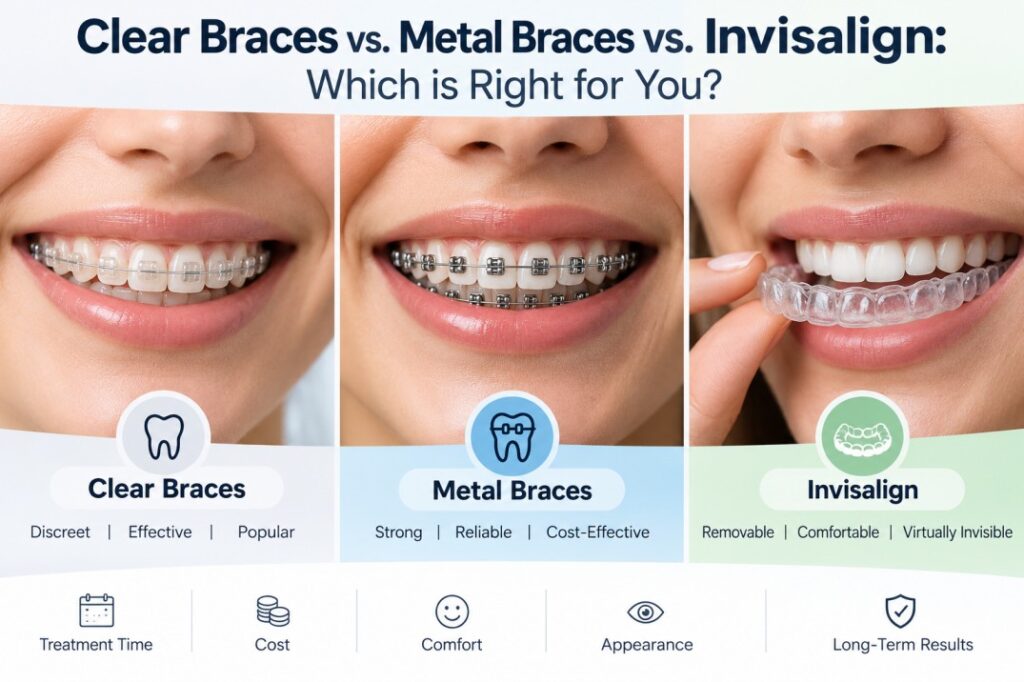
In this guide, we’re going to compare the three most popular options side-by-side. We’ll break down the pros and cons of Metal, Ceramic, and invisible orthodontics (aligners) to help you decide which one fits your life best.
Option 1: Traditional Metal Braces (The Reliable Classic)
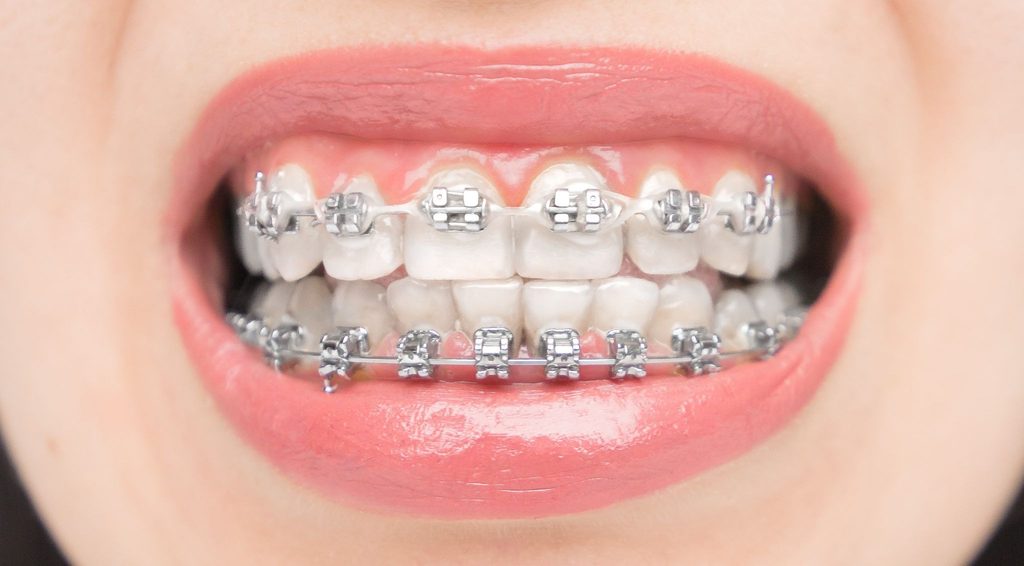
What are they? These are the braces most people are familiar with. They consist of high-grade stainless steel brackets glued to the teeth, connected by a thin metal wire.
Best for: They are the “heavy lifters” of the orthodontic world. They are excellent for fixing complex issues (like severe overcrowding or deep overbite orthodontics cases), treating children and teens, and for families working with a stricter budget.
The Pros:
- Efficiency: They are incredibly effective at moving teeth exactly where they need to go.
- Durability: Steel is strong. You don’t need to worry about them breaking easily.
- Cost-Effective: Generally, metal braces are the most affordable option.
The Cons:
- Visibility: There is no hiding them. However, many kids and teens actually love customising the coloured bands!
Option 2: Ceramic Braces (The “Best of Both Worlds”)
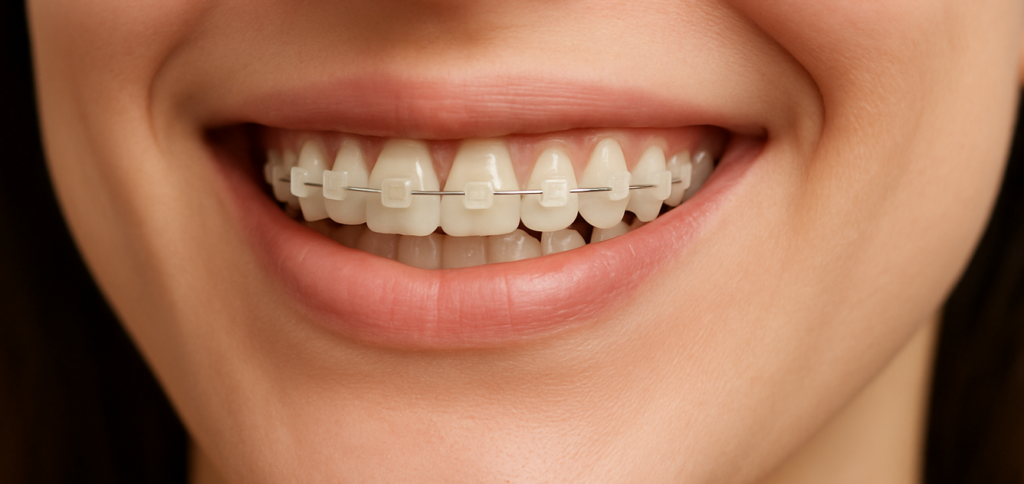
What are they? Ceramic braces work on the exact same mechanics as metal braces (brackets and wires), but with one major difference: the brackets are made from a clear or tooth-coloured ceramic material.
Best for: Adults and older teenagers who need the precision and power of fixed braces but want a much more discreet look. This is often called clear orthodontic braces treatment.
The Pros:
- Discreet: From a distance, they blend in seamlessly with your teeth, making them far less noticeable than metal.
- Powerful: Because they are fixed to the teeth, they can handle complex tooth movements just as well as metal braces.
- Stain Resistant: High-quality ceramic brackets won’t stain (though you still need to keep the little elastic ties clean!).
The Cons:
- Cost: The materials are more advanced, so they typically cost slightly more than metal.
- Care: While strong, ceramic can be slightly more brittle than steel, so you have to be a little careful with very hard foods.
Option 3: Clear Aligners / Invisalign (The Lifestyle Choice)
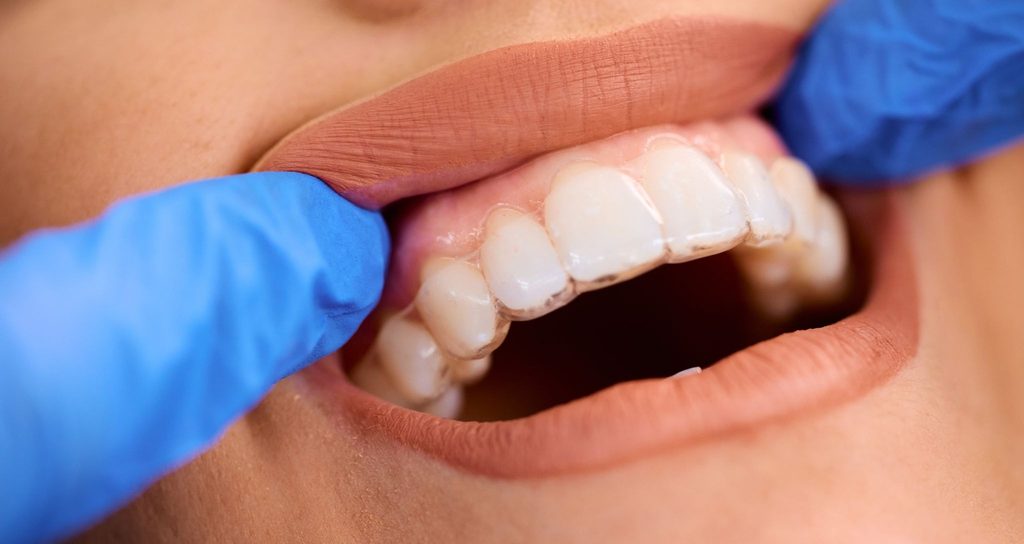
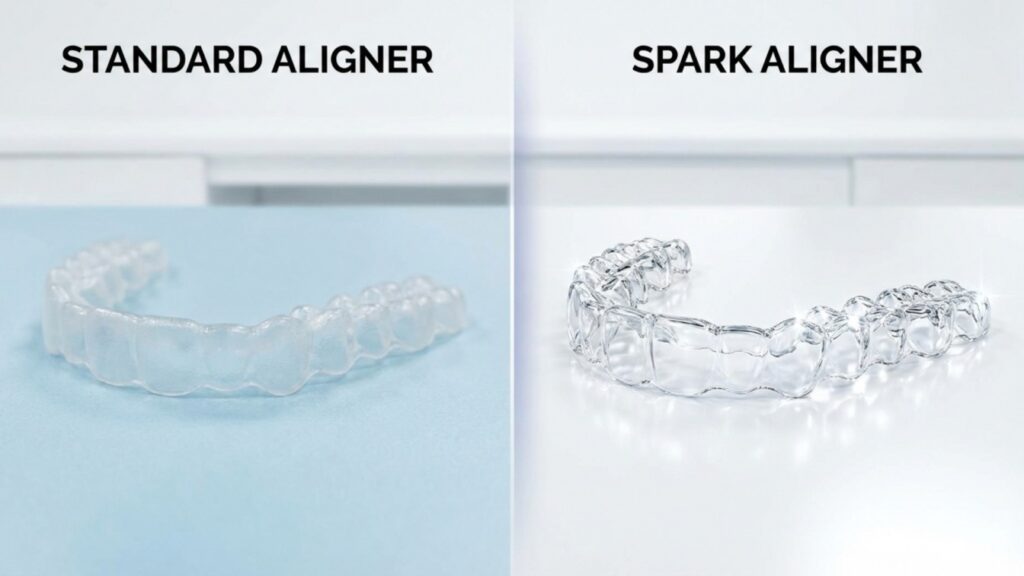
What are they? This is the modern world of invisible orthodontics. Instead of brackets and wires, this treatment uses a series of custom-made, clear plastic trays that fit snugly over your teeth. You change to a new tray every week or two to gradually shift your smile.
Best for: Adults and responsible teens who want the ultimate flexibility. They are perfect for mild-to-moderate alignment issues and for people who want their treatment to be a secret.
The Pros:
- Invisible: They are virtually undetectable when worn.
- Removable: You take them out to eat, meaning no dietary restrictions! You also take them out to brush and floss, making hygiene a breeze.
- Comfort: There are no metal wires to poke your cheeks.
The Cons:
- Compliance is Key: This is the big one. You must wear them for 22 hours a day. If you lose them or forget to put them back in after lunch, your teeth won’t move.
- Complexity: While technology has advanced, fixed braces (metal or ceramic) are still sometimes preferred for extremely complex bite corrections.
The Comparison: Factors to Consider

Still undecided? Here is a quick cheat sheet to help you compare:
- Hygiene: Aligners win here. Because you can take them out, you can brush and floss normally. With metal or ceramic braces, you need to thread floss under the wire (though it gets easier with practice!).
- Visibility: Aligners are the most invisible, followed closely by Ceramic braces. Metal is the most visible.
- Discipline: Braces win here if you are forgetful. Once they are on, they work 24/7 without you doing a thing. Aligners only work if you remember to wear them.
- Cost: Metal is usually the entry-level price point. Ceramic and Aligners are often comparable in price, though this depends on the complexity of your case. (For a detailed breakdown, check our guide on How Much Do Orthodontic Braces Cost in Australia?).
Conclusion: Which One Wins?
The truth is, there is no single “winner.” The best option is the one that fits your specific dental needs and your lifestyle.
- If you want the most affordable, “set-and-forget” option: Metal Braces.
- If you need the power of braces but hate the metal look: Ceramic Braces.
- If you need flexibility and want to hide your treatment: Clear Aligners.
Ultimately, the most important factor isn’t the tool—it’s the hands that use it. A specialist orthodontist can achieve stunning results with any of these methods. (Not sure who to see? Read our tips on How to Choose the Best Orthodontist).